

Cover Photo: Ramon FVelasquez / Wikimedia Commons
Photo: Ramon FVelasquez / Wikimedia Commons
1 / 1
The Philippine National Anthem is a declaration of Filipinos' ardour and love for the motherland
We sing the Philippine national anthem, Lupang Hinirang, with hands on our hearts and unbridled fervour. As the nation goes through unprecedented times, suddenly, every word uttered becomes a promise of love—a word that Filipinos are all too familiar with.


Above Photo: Einron Young / Wikimedia Commons
Photo: Einron Young / Wikimedia Commons
1 / 1
It Began with a Band
In 1898, a Filipino musician by the name of Julian Felipe was asked by the head of the Dictatorial Government of the Philippines, Emilio Aguinaldo to create a "stirring and majestic" instrumental that would serve as a ceremonial national march. As a patriot imprisoned for joining the revolution in 1896 alongside the 13 Martyrs of Cavite. Although Felipe was released, the 13 Martyrs (namely Maximo Inocencio, Jose Lallana, Eugenio Cabezas, Maximo Gregorio, Hugo Perez, Alfonso de Ocampo, Luis Aguado, Victoriano Luciano, Severino Lapidario and Feliciano Cabuco) were mass executed.
It was clear that Felipe had the artistry and ardour to create such an oeuvre.
He then composed Marcha Nacional Filipina, also known as Himno Nacional Filipino, which was performed by a band.
The Lyrics were Originally in Spanish
José Palma began composing verses while studying at Ateneo de Manila University. He joined the revolution in 1899 during the Philippine-American war. However, Palma often stayed in camps and entertained the soldiers with what he did best.
Soon, Palma wrote the Spanish poem, Filipinas, while in Bautista, Pangasinan after developing patriotism while becoming a staff of the revolutionary newspaper La Independencia. The poem was originally only intended for publishing.
The Translation
Above Photo: Pixabay / Pexels
Photo: Pixabay / Pexels
1 / 1
Palma's Filipinas was later translated to English, given that many spoke the language during the American regime. Camilio Osias and AL Lane's Land of the Morning became the official lyrics for the Philippine national anthem in 1938.
See also: Are we Filipinos Because We Love Music, or Do We Love Music Because We are Filipinos?
A Debate on Language
There were discussions on the country's national language. The idea of using the invader's language for the national anthem seemed amiss.
During the Japanese occupation, the first Tagalog translation was used—Diwa ng Bayan—which was used by the guerilla movement HUKBALAHAP. But it was Felipe Padilla de Leon's Lupang Hinirang that gained popularity and was later recognised as the lyrics for the national hymn in 1958.
Flag and Heraldic Code of the Philippines
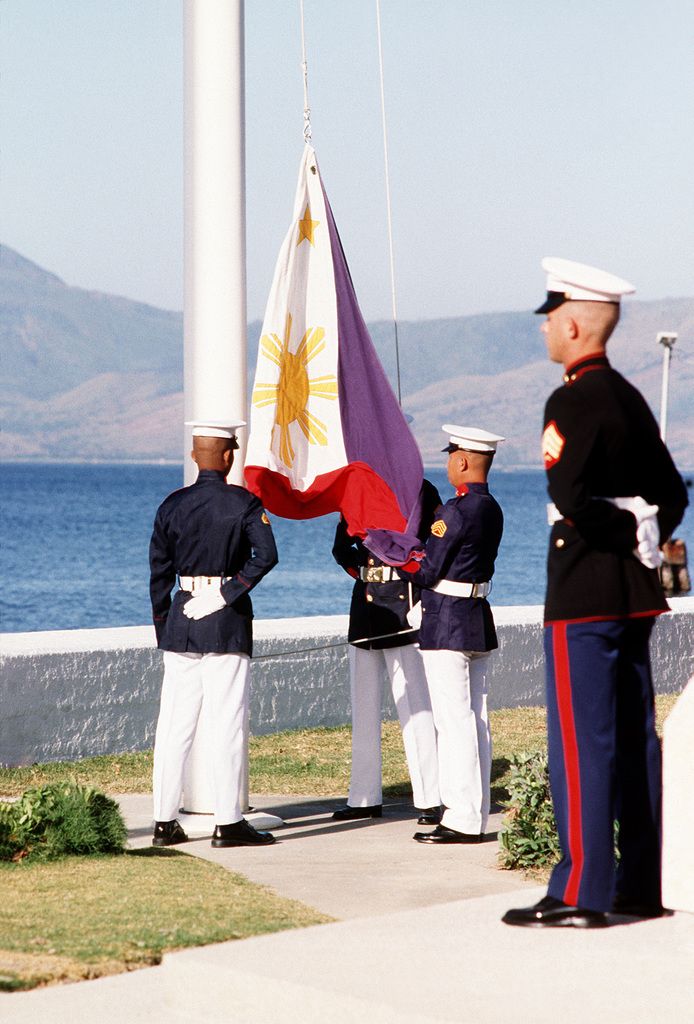
Above A U.S. Marine stands by as Philippine marines raise their flag over the naval station following the final close-out ceremony. Subic Bay Metropolitan Authority will be assuming control of the facility. (Photo: Picryl)
A U.S. Marine stands by as Philippine marines raise their flag over the naval station following the final close-out ceremony. Subic Bay Metropolitan Authority will be assuming control of the facility. (Photo: Picryl)
1 / 1
The attending public is required to sing the national anthem whenever it is played at a public gathering, be it during official or important occasions, during flag ceremonies in schools or offices, signing in and off broadcast stations, and before the last screening of films. People must show utmost respect when it is sung or played.
According to RA 8491, the Flag and Heraldic Code of the Philippines, the anthem should be in accordance with Felipe's musical arrangement and composition.
NOW READ
6 Traditional Filipino Musical Instruments You Should Know About
The Interesting History Behind Our Proud Philippine Flag
Hidilyn Diaz: 5 Things You Should Know About The Filipina Olympic Champion
Christine Andas is a features writer and the style lead of Tatler Philippines. She mostly covers style-related content but enjoys writing about space, sneakers, and her favourite stars. She acquired a master's degree in Creative Writing at the University of Santo Tomas and has written young adult short stories which can be read online.





